

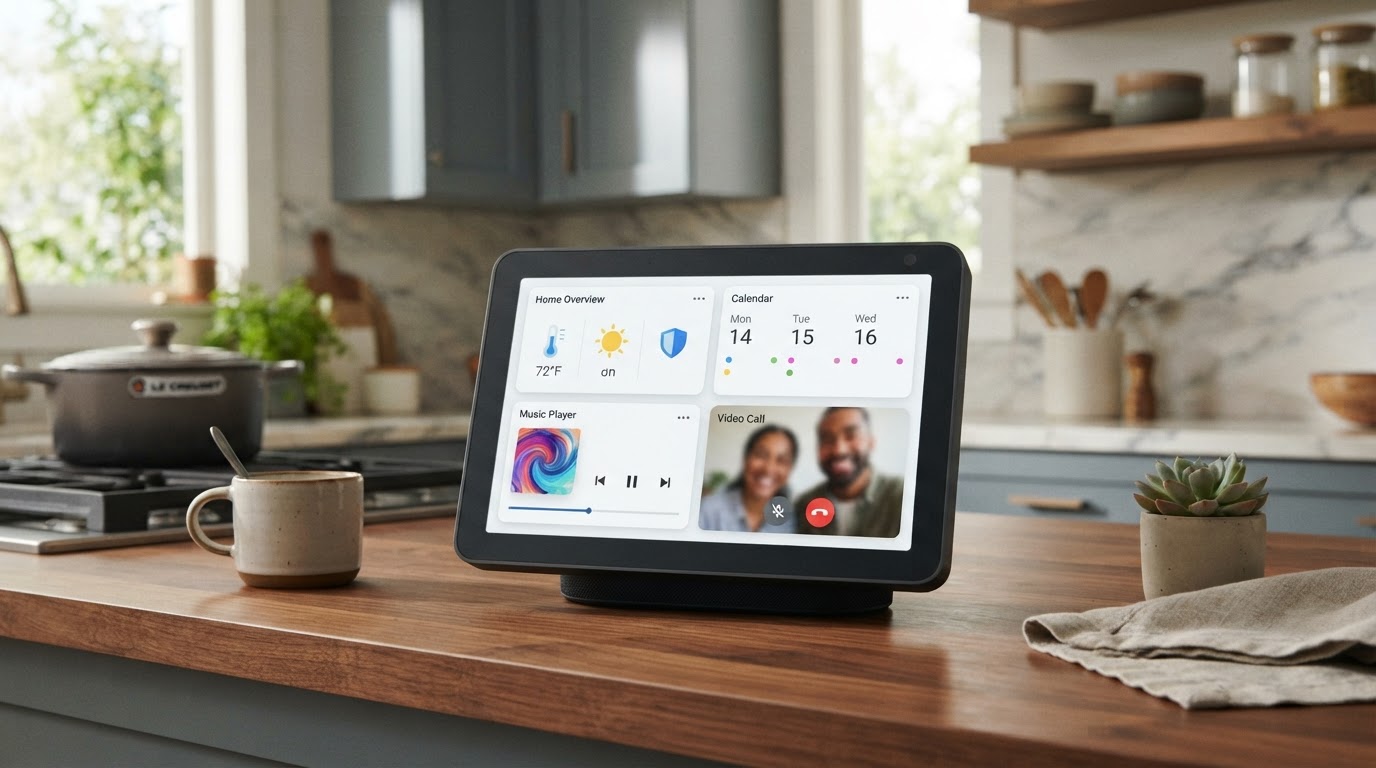
Apple has officially put HomeView on sale, introducing a new 7-inch smart display designed to sit at the center of a connected home. The device combines a screen for calendars, music, FaceTime and home controls with a new Siri AI experience that Apple says can understand more context and handle more involved requests. It is aimed at people who want a shared household screen rather than another tablet that needs to be picked up and carried around.
HomeView arrives in tabletop and wall-mounted versions, both priced at $299 in the United States. The launch is limited to selected countries, and there is an important regional catch: Apple says the device is not currently available in the European Union because Siri AI is not yet available there in the required form. That makes the product interesting for Apple’s smart-home strategy, but not an immediate option for many European buyers.
A shared display that changes depending on who is using it
The 7-inch Liquid Retina display is designed to show useful information at a glance. Users can play music, make FaceTime calls, check Calendar events, view reminders and manage compatible smart-home accessories. Apple says HomeView can recognize up to six people by face and adapt the information shown to each person. Messages, FaceTime, Calendar, Reminders and Find My can therefore become more personal without turning the device into a completely private screen.
That multi-user approach is one of the more interesting parts of the product. A shared display in a kitchen or hallway can be useful only if it does not expose one family member’s private messages or appointments to everyone else. Apple says personal content appears only when the person is recognized and their paired iPhone or iPad is present and has been recently unlocked. It is a more deliberate privacy model than simply putting a family calendar on a screen that anyone can read.
Siri AI is the main reason HomeView is different
Apple is positioning Siri AI as a more capable and conversational assistant, with broad world knowledge and awareness of what is on the screen. That means a user can ask a question about displayed information or request an action based on the current context. When paired with a compatible Apple Intelligence-enabled iPhone or iPad, HomeView can also draw on personal information in apps such as Calendar and Messages to provide more relevant answers.
The feature set sounds promising, but it is important to separate what is available at launch from what Apple is describing as the longer-term experience. Siri AI is still identified as beta in HomeView software, some functions depend on language and region, and certain server-based features have daily usage limits. Users should not assume every advertised capability works in every country or with every older Apple device. Apple’s HomeView launch announcement contains the detailed compatibility and availability notes.
Tabletop or wall-mounted: which model makes more sense?
The tabletop model is the more flexible option. It can sit on a kitchen counter, bedside table or desk, and is available in silver, starlight, rose pink and space gray. The wall-mounted version is designed for spaces such as an entryway or hallway, where a shared home dashboard may be easier to see. It comes in silver and space gray and can be paired with dedicated mounting and power accessories from Schneider Home.
Both versions work with Apple’s Home app for settings, automations and compatible accessories. That makes HomeView more than a digital photo frame, but it also means its value depends on how much of a household already uses Apple’s ecosystem. Someone with HomeKit-compatible lights, locks and sensors may find the display useful every day. A household that uses a mix of Google, Amazon and other smart-home platforms should check compatibility before buying. Apple’s Home app overview explains the wider smart-home ecosystem. Apple’s wider hardware direction is also worth a look in our coverage of the company’s latest iPhone, AirPods and Apple Watch announcements.
The biggest limitation is availability in Europe
Apple lists the initial launch markets as the United States, United Kingdom, Australia, Canada, India, New Zealand and Singapore. The company says HomeView is not available for sale in the European Union while Siri AI is unavailable in iOS in the EU. Siri AI on HomeView is also limited to English in the listed launch markets, with Canadian French support planned for a later software update. Those restrictions make the product’s initial reach narrower than the global iPhone and iPad launches people may expect.
HomeView is an intriguing new category for Apple, especially if the company can make a shared smart display feel genuinely personal without compromising privacy. At $299, it is not an impulse purchase, and its appeal depends heavily on Siri AI and the Apple Home ecosystem. For now, European users can follow the launch but cannot order the device locally. Apple’s official availability details are worth checking before making plans to import one. If you have just moved to a new Apple device, our practical guide to the first things to do after buying an iPhone covers the setup side of the ecosystem.