

Meta may be preparing to take its VR hardware in a very different direction. New images found inside Meta’s own software appear to show the company’s upcoming Project Phoenix headset, revealing a much slimmer design than the current Quest lineup.
The images were discovered in the firmware of Meta’s Horizon OS Prescription Lens app and appear to provide the clearest look yet at the headset. While Meta has not officially announced Phoenix or confirmed the leaked design, the latest visuals line up with what has been reported about the device for months.
A Headset That Looks More Like Glasses
The biggest difference is the form factor.
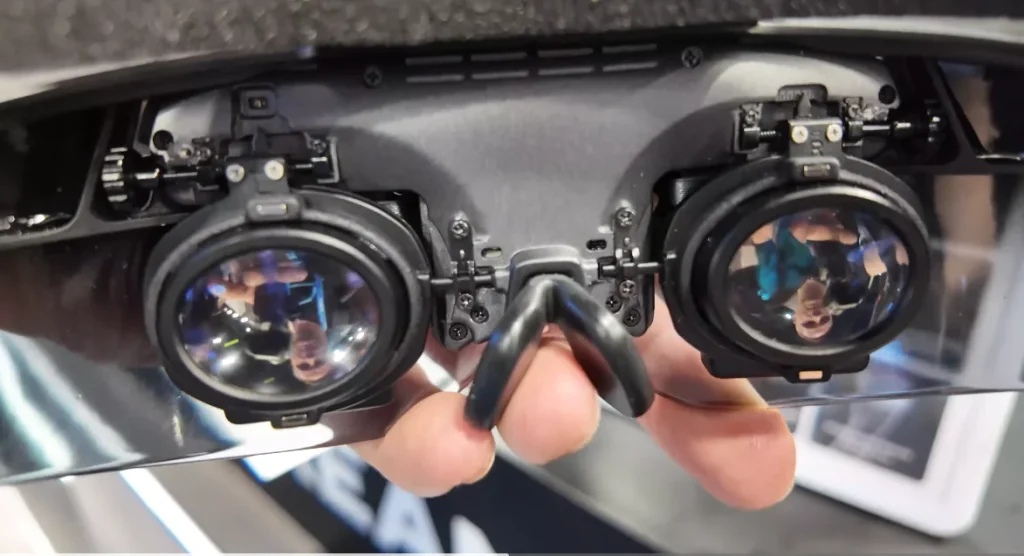
Rather than looking like a traditional VR headset with a large facial interface surrounding the user’s eyes, Phoenix appears considerably slimmer. The leaked visuals show what looks more like a pair of oversized glasses, with nose pads and an open-periphery design.
That doesn’t mean Phoenix is simply a pair of smart glasses. It is still expected to be a full mixed-reality headset using cameras for passthrough, similar in principle to the Meta Quest 3.
The difference is that Meta appears to be prioritizing weight and comfort much more heavily than it has with previous Quest hardware.
The Processing Happens in a Separate Puck
One of the most interesting aspects of Phoenix is that the headset itself isn’t expected to contain all of the hardware needed to run it.
Instead, Meta is reportedly developing a separate computing and battery puck connected to the headset by a cable. Moving some of the electronics and battery away from the user’s head should allow Meta to make the headset dramatically lighter.
The latest leaked images appear to show the cable coming from the rear of the left temple, while the headset itself remains relatively thin.
It’s a similar idea to what we’ve seen from some other companies experimenting with lightweight XR hardware. The tradeoff is obvious: users get a lighter headset, but they have to carry a separate device connected by a cable.
Phoenix Isn’t Quest 4
Despite the similarities, Phoenix shouldn’t be confused with Meta’s next traditional Quest headset.
Reports indicate that Meta is working on multiple next-generation devices, with Phoenix occupying a more premium and specialized position. UploadVR describes it as a spiritual successor to the Quest Pro, while a more conventional Quest 4 is expected later.
That makes Phoenix particularly interesting because Meta appears to be exploring different directions rather than simply making the next Quest headset faster.
The company seems to be asking a different question: what if a VR headset could become light enough to use for hours without feeling like you’re wearing a VR headset?
Virtual Screens Could Be a Major Focus
Phoenix is also expected to focus heavily on virtual screens, productivity and entertainment rather than traditional room-scale VR gaming.
That makes sense for a headset with this design. A lightweight device that can create large virtual displays could potentially work as a replacement for a television or computer monitor, particularly for people who spend long periods watching content or working at a desk.
Meta has previously discussed the idea of mainstream users entering VR primarily through media consumption before discovering gaming and other applications.
Micro-OLED Displays Could Make It More Interesting
There have also been reports that Phoenix could use 2,560 × 2,560 micro-OLED displays.
That information is less certain than the leaked physical design, and the original report about Meta’s display supply chain was disputed in part by Bigscreen. Still, if Phoenix does use micro-OLED panels at that resolution, it would represent a significant display upgrade over the LCD panels used in Quest 3.
Micro-OLED could provide better contrast and image quality while also helping Meta build a more premium product.
The QR Code Is One of the More Interesting Details
One small detail in the leaked images has also caught attention: a QR code appears on the side of the headset. It may look like an insignificant detail, but it could be related to manufacturing, testing or internal identification rather than something intended for consumers. The code itself doesn’t reveal any major new feature, but its presence adds another indication that the images may show an actual Meta hardware prototype rather than a generic concept design.

To me, this is also a reminder that Phoenix is still very much a work in progress. Hardware shown in internal software can change considerably before a commercial launch, so even details that look final in the leaked images shouldn’t necessarily be considered part of the finished product.
Meta Could Be Moving Beyond Controllers
Another important part of Phoenix is how users are expected to interact with it.
Reports suggest Meta is putting much more emphasis on eye tracking and hand gestures, potentially allowing users to control the interface using their gaze and a simple pinch gesture rather than traditional controllers.
That would make sense for a headset aimed at virtual screens and everyday use. Picking up controllers every time you want to open a browser or move a virtual window would hardly make the experience feel more natural.
When Will Project Phoenix Arrive?
Phoenix is reportedly targeting the first half of 2027, although Meta has not officially announced a launch date. Earlier plans apparently pointed toward 2026, but the project has since shifted.
There have also been reports that Meta was originally targeting a price below $1,000, although it remains unclear whether that target is still realistic.
For now, everything about Phoenix should be treated as unofficial. The latest images appear to come from Meta’s own firmware, which makes them more interesting than a random concept render, but the final hardware could still change before launch.
What We Know So Far
- Codename: Project Phoenix
- Type: Lightweight mixed-reality headset
- Design: Glasses-like, open-periphery form factor
- Computing: Separate tethered compute/battery puck
- OS: Horizon OS
- Displays: 2,560 × 2,560 micro-OLED has been reported, but isn’t confirmed
- Interaction: Eye and hand tracking are expected
- Launch: Reportedly first half of 2027
- Price: Previously reported below $1,000, but unconfirmed
If the leaked design is close to the final product, Phoenix could be one of Meta’s most interesting hardware changes yet. Rather than making another Quest headset that looks like a VR headset, Meta appears to be trying to make something people could actually wear for much longer periods — and that could ultimately matter more than another jump in raw processing power.
-
5 Things You Should Do Right After Buying a New iPhone
Buying a new iPhone is one of those tech upgrades that feels finished almost as…
-
Meta’s Project Phoenix Headset Leak Shows a Radical New Design
Meta may be preparing to take its VR hardware in a very different direction. New…
-

Hideo Kojima’s Physint Moves From PlayStation to Xbox After Sony Drops the Project
In one of the most surprising gaming stories of 2026, Hideo Kojima’s upcoming game Physint…
