For years, 8GB of RAM was enough for a lot of everyday laptops. That has changed. In 2026, 16GB has become a much more common starting point, while 32GB is increasingly available in mid-range and high-end machines.
That raises a simple question: if you’re buying a new laptop today, is 16GB still enough, or should you just pay more for 32GB?
For most people, 16GB is still a perfectly reasonable amount of memory. If your laptop is mainly used for web browsing, email, office applications, streaming, video calls and everyday software, there is little reason to assume that 32GB will suddenly make everything twice as fast.
What does RAM actually do?
RAM is essentially your computer’s short-term working memory.
When you open applications, browser tabs and files, your computer keeps the data it needs in RAM so the processor can access it quickly. The more RAM you have, the more information the computer can keep readily available.
The problem starts when you run out.
When available RAM becomes limited, the operating system can move some data to your SSD or other storage. Modern computers handle this automatically, but storage is considerably slower than RAM.
That is why having enough memory matters.
However, having more RAM than you actually need does not automatically make your laptop faster.
Is 16GB enough for everyday use?
For normal everyday computing, 16GB is a very comfortable starting point.
You can have a browser with numerous tabs open, Spotify running, a spreadsheet, a document, email and several background applications without constantly running into memory limitations.
For students, office workers and general home users, spending significantly more money just to move from 16GB to 32GB often isn’t necessary.
The processor, SSD, display and overall laptop design can have a much bigger effect on the experience.
When does 32GB make sense?
The situation changes when you start using more demanding applications.
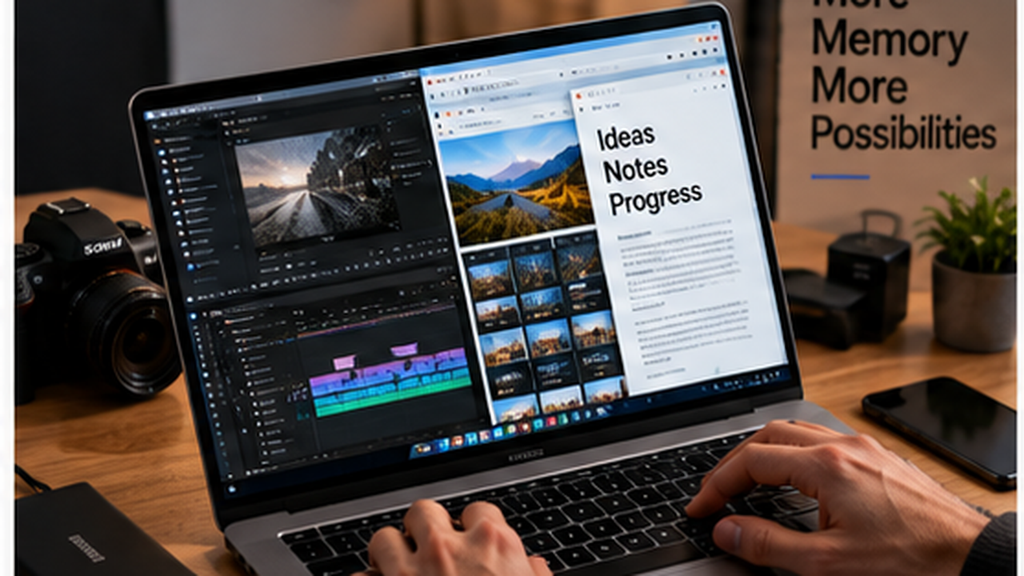
Video editing is one obvious example. A simple project can work perfectly well with 16GB, but large 4K projects, multiple video tracks, effects and other demanding workloads can benefit from having more memory.
The same applies to professional photo editing, 3D applications and other software that works with large files.
Gaming is a little more complicated.
Many games can run comfortably with 16GB, particularly when the rest of the system is properly balanced. Moving to 32GB can make sense if you also run other applications while gaming or want additional headroom for future games.
What about programming?
For normal programming, 16GB is usually sufficient.
The equation changes when developers start running virtual machines, containers, emulators, databases and several development environments simultaneously.
A developer who has an IDE, multiple browser windows, Docker containers and a virtual machine running at the same time can benefit significantly from 32GB.
In this situation, additional RAM isn’t about making one application dramatically faster. It is about preventing the whole system from running out of room.
Local AI changes the equation
Local AI is another reason some laptop buyers may want more memory.
Running AI models locally can require substantial system memory, depending on the model, software and configuration. If experimenting with local AI is an important part of your laptop plans, 32GB can provide considerably more flexibility.
It doesn’t mean every AI application requires 32GB, but it does give you more room to experiment.
Don’t forget whether the RAM is upgradeable
There is another factor that can be more important than the difference between 16GB and 32GB: whether you can upgrade later.
Many modern thin laptops use soldered memory. If you buy one with 16GB, you may be stuck with 16GB for the entire life of the machine.
If the laptop has upgradeable RAM, buying 16GB now and adding more later can be a sensible way to save money.
If the memory is permanently attached to the motherboard, however, paying for 32GB at the time of purchase becomes more attractive if you expect your workload to increase.
How much should you pay for 32GB?
This ultimately comes down to the price difference.
If moving from 16GB to 32GB costs only a relatively small amount, 32GB can be a reasonable choice for a laptop you plan to keep for several years.
But if the manufacturer charges a large premium, think carefully about whether you will actually benefit from the extra memory.
A laptop with 32GB isn’t automatically faster than an otherwise identical laptop with 16GB.
It simply has more room before memory becomes a limitation.
So, which should you buy?
For most people, 16GB remains the sensible baseline.
Choose 16GB if you mainly browse the web, work with documents, stream media, attend video calls and use normal productivity software.
Choose 32GB if you regularly edit video, work with large creative projects, use virtual machines, run demanding development environments or want to experiment with local AI.
There is also a good argument for 32GB if you’re buying a premium laptop with non-upgradeable memory and expect to keep it for five years or more.
The important thing is not to buy RAM simply because the bigger number looks better.
A well-balanced laptop with a good processor, fast storage and 16GB of RAM can be a much better machine than one with 32GB paired with weaker hardware.
For most buyers, 16GB is still enough. But 32GB is becoming an increasingly sensible option for power users and long-term laptop buyers.
Blog
This section provides an overview of the blog, showcasing a variety of articles, insights, and resources to inform and inspire readers.
-

What Actually Matters When Buying a New Wi-Fi Router?
Buying a Wi-Fi router used to be relatively simple. You would look at the advertised…
-
Do You Really Need 16GB of RAM in a Laptop
For years, 8GB of RAM was enough for a lot of everyday laptops. That has…
-

OpenAI Says Its AI Has Made a Breakthrough on a Famous Math Problem
OpenAI says one of its internal artificial intelligence systems has produced a solution to the…
